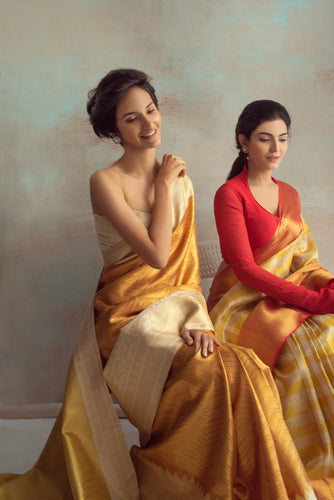

In the heart of every bride rests a quiet symphony of emotions hope, joy, love, and the gentle anticipation of a new beginning. The Blushing Brides collection by Muhurth is shaped around these unspoken feelings, offering bridal Kanjivaram silk sarees that feel as personal as the moment itself. Each saree is thoughtfully crafted to honour the essence of the muhurtham, ensuring she feels radiant and cherished on her special day.
From the soft blush that lingers to the thoughts she carries into the future, every emotion finds a place within the weave. The silk settles with ease, the zari catches the light as she moves, and the saree becomes a gentle extension of her presence. Whether she leans towards a traditional celebration or a modern affair, the Blushing Brides collection promises to adorn her with elegance and grace making her feel like the most beautiful version of herself.
Muhurth understands that no two brides are the same and this collection reflects that diverstity with care. From rich zari brocades and traditional korvai weaves to luminous tissue Kanjivaram silk sarees and classic vintage drapes, the collection brings together time-honoured techniques with a sense of ease. Each saree is designed to enhance the beauty of the bride holding the quiet significance of the moment she steps into.
For the bride who wants nothing but the best on her wedding day, the Blushing Brides collection is the perfect choice. Let Muhurth be a part of your unforgettable moment, where your dreams and emotions find their perfect expression in silk.
Explore Muhurth’s Blushing Brides collection of bridal Kanjivaram silk sarees, thoughtfully created for weddings, pre and post wedding muhurtham ceremonies and moments that stay with you long after they have passed.

FAQs – Blushing Brides Collection
1. What is the significance of a Kanjivaram silk saree in a wedding?
A Kanjivaram silk saree holds significance in weddings not only for its visual richness but also for the intrinsic nature of silk itself. Pure silk, produced by the Bombyx mori silkworm, is a continuous natural filament that retains its strength through the weaving process. This uninterrupted structure is believed to hold and transmit energy, which is why silk has long been associated with well-being and spiritual balance.
In South Indian traditions, silk is worn during muhurthams and auspicious rituals as it is thought to harmonise with the wearer’s energy while offering a sense of protection. For a bride, a Kanjivaram silk saree becomes more than ceremonial attire. It is chosen as a fabric that aligns with the significance of the moment, bringing together tradition, intention and a sense of completeness.
2. Which Kanjivaram silk saree is best suited for a bride?
Weddings being one of the most significant moments in one’s life, a bridal Kanjivaram silk saree is chosen with the intention of making the occasion truly memorable. It is a time when one may choose not to compromise on the quality of silk, the authenticity of zari, or the depth of handwoven craftsmanship that defines the saree.
A wedding saree is expected to carry a certain presence through the ceremony while also holding its beauty over time. Designs with rich zari brocades, traditional korvai borders, classic Vaira Oosi, elaborate pallus and intricate detailing are often preferred as they bring together structure and richness. The right saree is one that reflects the importance of the occasion while feeling natural to the bride, allowing her to step into the moment with ease and confidence.
3. Why are bridal Kanjivaram silk sarees expensive?
Bridal Kanjivaram silk sarees are valued for the quality of raw materials and the time-intensive process involved in weaving them. Pure mulberry silk and authentic zari contribute significantly to the cost, along with the skill and precision required from the weaver. Sarees with intricate brocades, korvai borders, or multiple shuttle weaving techniques like Meenakari , tissues take several days to complete, making them a result of both material richness and craftsmanship.
4. What is the difference between pure zari, half fine zari, and tested zari?
Pure zari is made using a silk core wrapped with silver and plated with gold, giving it a rich tone and long lasting quality. Half fine zari also uses a silk base but replaces silver with copper and uses a lower gold content, offering a similar look at a more accessible value. Tested zari is made with a synthetic core and metallic coating, which may resemble traditional zari but does not offer the same durability or authenticity. For a detailed understanding of zari types and quality, you can explore our complete guide.
5. How long does it take to weave a bridal Kanjivaram silk saree?
The time required to weave a bridal Kanjivaram silk saree depends on the complexity of the design. A standard korvai saree may take around 5 to 7 days on the loom, while sarees with designs that involve multiple-shuttle weaving techniques such as double nada brocade, Meenakari work, Vaira Oosi, Tissue weaving, or Rangkat constructions as in this collection demand far greater precision and time. Depending on the level of complexity, these elaborate handwoven Kanjivaram silk sarees can take anywhere between 15 to 45 days of weaving on the loom.
6. What is the difference between a bridal saree and a reception saree?
A bridal saree is typically richer in weave with a higher presence of zari, detailed craftsmanship and structured elements such as korvai borders , meenakari motifs, elaborate pallus. It is chosen to hold a certain depth and presence during the wedding ceremony, reflecting the significance of the muhurtham.
A reception saree, on the other hand, allows for a more expressive and contemporary approach. While it may still carry zari, the focus often shifts towards fluidity, lighter drapes, and elements of shimmer and bling that catch the light beautifully. This makes it well suited for an evening setting with a touch of glamour for the celebration.
7. Which sarees are suitable for bridesmaids and family members?
Bridesmaids and close family members often choose Kanjivaram sarees that complement the bride’s attire without drawing focus away from her. Sarees with coordinated colours, lighter zari work, or simpler designs help create a balanced and harmonious look during the ceremony.
Muhurth’s Time Honoured collection has curated sarees that work beautifully for bridesmaids and family, offering designs that align with the bridal saree while allowing each wearer to have a distinct presence creating a sense of visual unity, where everyone feels part of the occasion while the bride remains at the centre of it.
8. What colours are traditionally chosen for bridal Kanjivaram silk sarees?
Traditional bridal colours often include shades such as red, maroon, gold and auspicious hues like turmeric yellow and vermilion tones. These colours have long been cherished for their association with prosperity, joy and new beginnings in Indian wedding traditions. Today, new-age brides are also embracing softer pastel tones such as blush pink, powder blue, sage green, lavender and peach, bringing a lighter, more personal expression to the bridal Kanjivaram while keeping the beauty of the occasion intact.
9. What colours are ideal for the bride’s mother?
Deeper tones such as maroon, emerald green, navy and traditional reds are often preferred as they carry a sense of depth and presence. Depending on the occasion, softer tones can also be chosen for a more understated look.
Featured Products