
The older the weave, the quieter its beauty.
Each Vintage Kanjivaram reminds us of a time when design held intention, colours carried cultural meaning, motifs had significance and every element followed a disciplined aesthetic language. There is something deeply familiar about these sarees, even when we cannot quite explain why.
Perhaps it is because they bring back the women who wore them.

A grandmother on an early morning of a special day, already dressed and ready before the rest of the house awakens, her saree softly rustling as she moves through quiet rituals. Or a mother, standing before the mirror in the gentle rush of a celebration, adjusting her pleats with practiced ease as the contrast of her saree comes alive when she turns, ready to step into a moment that will be remembered long after.
These are the images that vintage Kanjivarams often bring with them. They carry moments, gestures and a sense of belonging that can linger across generations.
When Colour Had a Language
Rooted in this philosophy, Vintage Kanjivarams are defined by their strong, unapologetic use of colour.
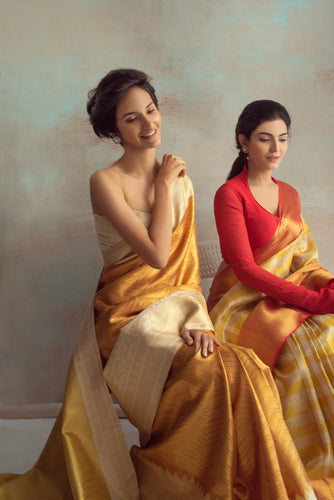
Deep arakku, classic reds, temple greens, rich rani pinks and warm manjal tones form some of the most recognisable colours of this vocabulary. Often placed against a contrasting border or pallu, they have a presence that comes from the colour itself rather than from an abundance of embellishment.
There is something particular about these combinations. They feel familiar without feeling dated. A deep green with rani pink, arakku with gold, a warm yellow against a traditional red. These are combinations that have lived through generations of celebrations and continue to feel instinctively right.
Colour was never an afterthought. It was part of the character of the saree.
The Beauty of a Measured Design
The design language remains deliberate and restrained. Bodies are typically adorned with small, repeating buttas like Annam, Chakaram, Yaanai, Mayil, florals or rendered in traditional layouts like kattam (checks), vaira oosi or veldhari patterns.
The motifs are given room to breathe, allowing the body of the saree to retain its rhythm without becoming crowded.
Borders too follow a classical approach, often narrower or medium in scale, with korvai constructions that bring contrast into focus. From a simple karai or selvedge to a finely detailed traditional border, proportion remains central to the design.
The pallu carries this language forward through customary motifs and traditional arrangements, bringing the different elements of the saree together naturally.
What Does “Vintage” Mean in a Kanjivaram?
When we speak of vintage Kanjivarams today, the word can refer to two things.
There are older sarees that have survived from an earlier period, carrying with them the colours, motifs and proportions of the time in which they were woven. Then there are contemporary Kanjivarams that return to these older design languages, recreating familiar colours, motifs and layouts for a new generation.
The distinction is worth knowing. An old saree carries the passage of time itself. A newly woven vintage-inspired saree carries the memory of a design language that has endured.
Both have their own place.
A Connection That Grows with Time
At Muhurth, these designs have never felt like something distant or rediscovered. They are part of a textile vocabulary we have grown up around, across generations.

When you spend enough time with Kanjivaram silk, certain things become familiar without needing much explanation. You begin to notice how a colour sits against another, how a border changes the feeling of a saree, how a small motif can alter the entire rhythm of the body.
Perhaps that is why older Kanjivaram designs continue to draw us back. They have a way of feeling known. And maybe that is what we are really drawn to in a vintage Kanjivaram, not simply that it belongs to another time, but that some part of it already feels like it belongs to us.
At Muhurth, our Vintage Kanjivaram collection revisits these enduring design principles. Crafted from 100% pure mulberry silk and handwoven with precision, each saree reflects a time when craftsmanship was guided by purpose and clarity and a saree was chosen not just for a moment but to be remembered in many more to come.
Featured Products