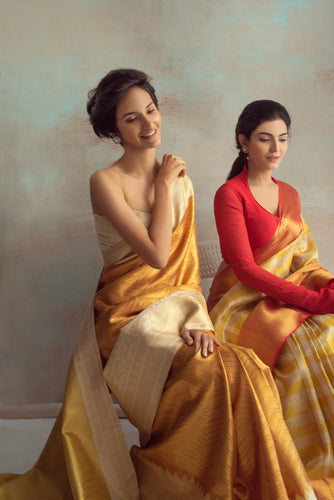

Vaira Oosi is one of the earliest and most refined weaving techniques in the history of Kanjivaram silk sarees. This technique traces back to a period before jacquard looms and elaborate brocade weaving became part of Kanchipuram silk traditions. During that time weavers explored ways to enhance the richness of silk sarees by incorporating authentic zari directly into the warp of the fabric. The fine and continuous placement of zari threads across the silk created a luminous surface that reflected grandeur and restraint at the same time. Such sarees were often woven for royal patronage and temple deities where the radiance of the attire held ceremonial importance.
In earlier periods these sarees were woven using pure gold zari. Because zari threads are finer and more delicate than silk they required exceptional control during weaving. The weaver had to maintain consistent tension across the loom as even a slight break in the zari thread demanded careful mending before the weaving could continue. This process required immense patience, precision and mastery which made Vaira Oosi weaving a true mark of a skilled artisan.
The beauty of a Vaira Oosi Kanjivaram silk saree lies in its discipline. Fine uninterrupted lines of zari run across the silk creating a subtle and refined shimmer rather than an overtly ornamental surface. There is no excess decoration and no elaborate embellishment. The richness emerges through balanced rhythm and the quiet brilliance of silk and zari working together.
Because of the sheer volume of authentic pure gold zari used in the warp, these sarees were once regarded as the pinnacle of luxury in Kanjivaram weaving. Their value lay not only in the material but also in the time consistency and expertise required from the weaver to complete the saree with precision.
Over time the elegance and restraint of Vaira Oosi weaving has made it one of the most cherished forms of a pure Kanjivaram silk saree. Many collectors and connoisseurs consider it a timeless addition to their wardrobes and an ideal choice for weddings, bridal trousseau and festive celebrations.
At Muhurth this historic weaving tradition continues to live on our looms. These vintage Kanjivaram weaving techniques are preserved by skilled artisans who carry forward the discipline and knowledge of generations. Even as contemporary expressions evolve within Kanjivaram silk weaving the essence of Vaira Oosi remains unchanged. It stands timeless in form defined by restraint precision and the enduring elegance of luxury handwoven Kanjivaram silk sarees.

FAQs – Vaira Oosi Kanjivaram Silk Saree Collection
1. What is the meaning of Vaira Oosi in a Kanjivaram silk saree?
Vaira Oosi or million needle technique refers to the fine needle-like lines of authentic zari that run across the warp of the saree. In this weaving technique, very delicate and closely placed zari lines are incorporated across the body of the saree along with the silk threads. These fine and intricate zari placements create a soft luminous surface across the fabric and give the saree its characteristic shimmer. The beauty of Vaira Oosi lies in this subtle radiance where the brilliance of zari blends gently with the richness of handwoven silk.
2. Is Vaira Oosi a GI tagged weaving technique?
Vaira Oosi itself is not an individual GI tagged technique. However it forms part of the broader tradition of Kanchipuram silk saree weaving which holds a Geographical Indication tag. This recognition protects the authenticity of sarees woven in the Kanchipuram region using traditional methods and materials.
3. What makes Vaira Oosi weaving unique in Kanjivaram silk sarees?
The Vaira Oosi technique is defined by uninterrupted zari lines woven across the silk with remarkable control. Unlike heavy brocade designs, this style relies on precision and uniformity, creating an elegant surface that highlights the skill of the weaver.
4.How long does it take to weave a Vaira Oosi Kanjivaram silk saree?
The weaving time depends on the design and the density of zari used in the saree. Since Vaira Oosi involves continuous lines of zari across the silk it requires consistent tension and careful control on the loom. This process demands patience and precision from the weaver which naturally extends the weaving time from 15-45 days to complete on the loom.
5. How to identify a high-quality Vaira Oosi Kanjivaram Silk Saree?
A high quality Vaira Oosi Kanjivaram silk saree can be recognised by the precision of its zari lines across the body of the saree. The zari should appear as fine closely placed parallel lines that run consistently across the warp of the fabric. This uniformity reflects the control and skill of the weaver during the weaving process. The quality of the zari also plays an important role as authentic zari lends the saree a refined and luminous sheen.
6. Are Vaira Oosi Kanjivaram silk sarees suitable for weddings and special occasions?
Yes. The luminous zari surface and refined craftsmanship make Vaira Oosi Kanjivaram silk sarees an elegant choice for weddings, receptions and ceremonial occasions. The subtle radiance created by the fine zari lines across the silk lends the saree a distinguished presence while retaining the grace of traditional Kanjivaram weaving. These sarees are also well suited for festive gatherings, temple ceremonies and important celebrations where the timeless elegance of handwoven Kanjivaram silk is truly appreciated.
7. How should a Vaira Oosi Kanjivaram silk saree be cared for?
Since Vaira Oosi sarees contain a greater presence of fine zari across the body, extra care should be taken while folding and storing so that the zari threads do not weaken or break along the creases. Air dry the saree after every use before storing it and keep it in a breathable cotton cloth. Proper storage and periodic refolding help protect both the silk and the delicate zari allowing the saree to retain its richness and elegance over time.
Featured Products