
Ask any woman who has been to a Valaikappu. Without plan, without coordination, without a group chat deciding it, the women arrive in green. Mothers. Mothers-in-law. Aunts who have watched this ritual unfold across generations. They simply know. This is what unspoken cultural memory looks like.
Valaikappu comes from two Tamil words. Valai meaning bangles and Kappu meaning protection. A ceremony named after the act of sheltering new life. Telugu families call it Seemantham, also known as Gajulu Todagadam, the wearing of glass bangles and Poolu Mudupu, the adorning of flowers in the hair. In Kannada homes it is Seemantha. In the North, Godh Bharai, meaning to fill the lap. The rest of the world calls it a baby shower. The names differ. The women who arrive and why they arrive remain the same across every home.

Before the mother-to-be is even seated, the house speaks. Maavilai thorans hang at the entrance, strings of fresh mango leaves tied across the doorway, the oldest welcome a South Indian home knows how to give. Mango leaves in Tamil tradition signify fertility, prosperity and the presence of something auspicious about to happen inside. The green at the door and the green on the women are the same message, said in two different ways.
Green is pasumai in Tamil. Lush, fertile, alive. It is Maragadha Pachai, the emerald of the Navaratnas. In the Shastra texts, emerald is associated with Mercury and with growth, with things that are still becoming. The weavers of Kanchipuram understood this long before it was written anywhere. Green was one of the oldest colours on the loom, long before synthetic dyes arrived in the 1860s. Pasi pachai (olive green), Manthulir (the exact shot colour of tender mango leaves), violet meeting green at just the right angle. These colours carry centuries of intention. Each shade chosen by a weaver was a decision rooted in the rhythms of nature and the rituals of life.

On pure mulberry silk, every green softens and deepens in equal measure. The colour finds its full expression only on this fabric.
Green is the colour of the mother-to-be. She carries the ceremony within her and the ceremony is built around her.
In the seventh month, when the pregnancy has settled and the family is ready to gather, the mother-to-be is dressed, adorned, celebrated. Red and green glass bangles are slid onto her hands in odd numbers, because odd numbers here signal continuation, not conclusion. The sound of those bangles, the tradition holds, reaches the baby in the womb. Fetal hearing begins in the seventh month. The ceremony knew this long before medical science confirmed it. Before the child takes its first breath, it hears the women of its family arriving. That is what the Valaikappu is.

The seer varisai thattu, known as Naandi Koodu in Telugu and Nandi Varishe in Kannada, arrives with fruits, sweets, flowers and fresh bangles, everything she has been craving, placed before her without question. This is the one occasion where every want of hers is honoured without a word of negotiation. She sits at the centre of it all, sandalwood and turmeric cool on her hands and cheeks, jasmine in her hair, wearing the green Kanjivaram her mother chose for her. Of all the things that arrive that day, the saree is the one she will keep the longest.
A Kanjivaram saree belongs to this ceremony the way jasmine belongs in her hair. It is woven into the ritual and into the memory the child will one day hear about.

Imagine the scene. The mother-to-be wears green, a Kanjivaram chosen by her mother, the colour decided long before the date was fixed. She is the ceremony. Everything is arranged around her.

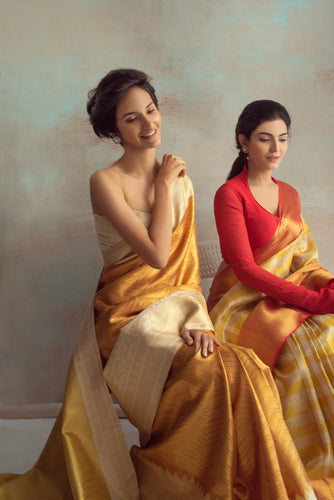
And now picture the women who love her, arriving one by one. Tradition places green on the mother-to-be alone, but imagine if the room filled with every shade of it. The mother-in-law in sampanga, that particular green edged with gold, who has held every detail of this day together and will not let it show. The mother in bottle green, pure zari, who arrives with the seer varisai, a weight that needs no announcement. The sister-in-law in sea green, a shade that moves with her as she moves through the room, present everywhere at once. The friend who drove four hours in elaichi green, the lightest shade in the room, worn by the person who arrived without being asked. The grandmother in a Korvai Kanjivaram, that combination Kanchipuram weavers have been perfecting for generations, worn by the woman who has seen the most and says the least. The young cousin at her first Valaikappu in soft, minimal green, still learning what it means to be one of these women.
This is the colour architecture of a Kanjivaram celebration. Each shade distinct, each woman present in her own way, all of them forming a circle around the one at the centre.
Browse the Korvai Kanjivaram collection for the contrast-border weaves that have defined this ceremony across generations. For the mother-to-be, the Valaikappu Green collection offers greens in their purest, most ceremonial form. For the women who arrive in quiet elegance, explore the full Shades of Green collection and the Minimalist Kanjivaram collection.
How Valaikappu Is Celebrated Across Communities
The heart of the ceremony remains the same: bangles, blessings and the gathering of women. The rituals around it vary by region, caste and family tradition.
The Black Saree: Masakkai Karuppu
In many Tamil households, the Valaikappu begins before the seventh month. In the fifth month, the mother-to-be's parents present her with a black saree, a practice called Masakkai Karuppu. In Tamil customs, black is reserved for this one occasion. During pregnancy it is worn specifically to ward off the evil eye, especially from the food she craves. In some Brahmin households too, the mother-to-be wears a black saree at the Valaikappu for the same reason, making it the rare occasion in Tamil tradition where black is welcomed and worn with intention.

Udaya Shanti: When the Vedas Reach the Womb
In many Brahmin households, the Valaikappu or Seemantham is accompanied by a ritual called Udaya Shanti (also known as Udaka Shanti). During this ritual, Vedic hymns including the Sri Rudram are recited by priests in the presence of the mother-to-be. The intention is protective and generative. The sacred sound is believed to reach the child in the womb, making this the baby's first encounter with the Vedic tradition. Fetal hearing develops around the seventh month, so the timing of the ceremony carries both spiritual and scientific resonance. The child hears the Rudram before it hears anything else of the world outside.
Telugu Seemantham: Gajulu Todagadam and Poolu Mudupu
In Telugu families, the Seemantham is celebrated as Gajulu Todagadam (the wearing of glass bangles) and Poolu Mudupu (the adorning of flowers in the hair). The regional differences within Telugu-speaking communities are distinct. In the Telangana region, Seemantham is performed in the fifth or ninth month, as the seventh is considered inauspicious, while in the Andhra region it is typically held in the seventh month. The gifts brought by the mother's family, a saree with two blouse pieces and a basket of sweets and savouries including Sakinalu, Arasalu and Garjalu along with seasonal fruits, mirror the spirit of the seer varisai thattu across the border.
Kannada Seemantha
In Karnataka, the ceremony is called Seemantha and carries the same core rituals: bangle-placing, the gathering of married women and the gifting of sarees and sweets. Among Madhwa Brahmin families, the ceremony carries additional Vedic significance, with specific mantras recited for the health and protection of the child. The saree gifted to the mother-to-be, often a Mysore silk or Ilkal, holds the same meaning as the Kanjivaram does in Tamil homes. It is the garment she will keep the longest.
What Remains the Same
Across all these communities, Tamil, Telugu, Kannada, Brahmin and non-Brahmin, North and South, certain things do not change. The odd number of bangles. The sandalwood and turmeric on her hands. The seer varisai placed before her without question. And the understanding, held without being spoken, that this ceremony is for the child as much as it is for the mother. Sound, warmth, the voices of the women who will raise it. This is what the child receives first, before it is even born.

The Kanjivaram Saree for Valaikappu: A Buying Guide
Whether you are dressing the mother-to-be or gifting a saree for her ceremony, here is how to navigate the Muhurth collections for a Valaikappu Kanjivaram saree:
For the mother-to-be: Green, in its fullest expression. A single, deep, uninterrupted green on pure mulberry silk. The Valaikappu Green Collection is where to begin. One colour, complete, ceremonial.
For the Korvai border tradition: A weave where the border and body are woven separately and joined on the loom, the contrast border Korvai is one of Kanchipuram's oldest signatures. Browse the Korvai Kanjivaram collection for this tradition.
For the women who arrive: Clean lines, quiet silk, a green that speaks softly. The Shades of Green collection carries every hue in the green family, holding the softer shades, elaichi, sea green and manthulir and the Minimalist Kanjivaram collection is for the women who hold the ceremony together.
For something rooted in tradition: If the family follows the older weaving conventions, the Vaira Oosi border, the classic temple motifs, the zari weights of another era, the Vaira Oosi Kanjivaram collection carries that lineage. For a complete view of every Muhurth weaves, the Time-Honoured Kanjivaram collection is where to begin.
Be part of what she remembers. Gift her green.
Featured Products